VitruvianAI News
Multi-source · multi-platform

Daily AI news,
posted to every social feed.

Vitruvian scans dozens of trusted AI sources, picks the stories worth knowing, designs each post, and ships them to every feed — every single day.

Pipeline · dailylive · running
02
Generate· Copy + design
Vitruvian Engine
Generates copy & design
live
03
Publish· All platforms
Soon
Soon
Soon
Soon
Live on social

A peek inside @vitruvianainews

On Instagram
@vitruvianainews
View profile →
vitruvianainews

vitruvianainews For the first time at scale, big tech employers are explicitly citing AI, not a down economy or post-pandemic correction, as a driver behind significant headcount reductions in 2026. TechCrunch has been tracking the announcements in reverse chronological order as they come in, and the list keeps growing. What makes this wave different is the candor. Companies in previous years tended to blame macro conditions or strategic pivots. This year, many are stating outright that AI tools are reducing the need for certain roles, particularly in software engineering, customer support, and content operations. The pattern raises urgent questions about retraining pipelines, severance standards, and whether regulators will eventually require companies to disclose AI's role in workforce decisions more formally. #AI #TechLayoffs #AIJobs #FutureOfWork #Automation

vitruvianainews

vitruvianainews OpenAI has launched Patch the Planet, a program under its Daybreak initiative that gives open-source maintainers access to AI tools and expert reviewers to find, validate, and fix security vulnerabilities in their projects. The initiative targets a well-known gap in software infrastructure: thousands of widely-used open-source libraries are maintained by small teams or solo developers who lack the time and resources to run thorough security audits. By combining automated AI scanning with human oversight, Patch the Planet aims to close real vulnerabilities before they can be exploited at scale. The announcement, published June 22, 2026, positions Daybreak as OpenAI's umbrella for applying its models to high-stakes public-good problems, with open-source security being the first major focus area. #OpenAI #OpenSource #CyberSecurity #PatchThePlanet #Daybreak

vitruvianainews

vitruvianainews AI agents have gone from answering one question at a time to running in persistent, self-directed loops. The idea is straightforward: instead of triggering an agent to complete a task and then stopping, you authorize a swarm of agents to keep working in the background, indefinitely, handing work between each other as new sub-tasks arise. This is a meaningful step beyond basic agentic AI. Earlier systems were reactive, waiting for a human prompt before acting. Looping swarms are proactive by design, which means the human hand-off happens once at the start, not at every step. The practical upside is speed and scale: complex, multi-part workflows that would take days of back-and-forth could run overnight without human check-ins. The downside is that errors can compound just as fast, and the question of when (and how) to pull the plug becomes genuinely complicated. #AI #AgenticAI #AIAgents #AIResearch #MultiAgentSystems

vitruvianainews

vitruvianainews SpaceX has signed a long-term compute agreement with Reflection AI, an open-source AI lab, worth $150 million per month starting July 1, 2026 and running through 2029. That works out to roughly $1.8 billion a year in guaranteed revenue for SpaceX's data center arm. The hardware at the center of the deal is Nvidia's GB300, the company's latest generation of AI accelerator chips. Reflection AI will have immediate access to those chips and the surrounding infrastructure inside SpaceX's Colossus 2 facility, which sits near Memphis, Tennessee. The scale of the commitment underscores how quickly demand for frontier AI compute has outpaced what traditional cloud providers can supply, pushing labs to lock in capacity directly with specialized operators like SpaceX. #AI #SpaceX #ReflectionAI #Nvidia #AIInfrastructure

Supported platforms

Every feed, designed for the feed.

These are all the platforms Vitruvian renders for — natively sized, properly captioned, published on cadence.

liveX / TwitterliveInstagram
soonLinkedIn
soonThreads
soonFacebook
soonTikTok

The maker

Designed & engineered by

Felipe Freitas

Software Engineer

Vitruvian started from a personal itch: keeping up with AI was getting impossible — models, papers, launches, demos, drama, all of it scattered across a dozen feeds. So I built the one I wished existed.

And the name? A quiet tribute to Leonardo da Vinci — engineer, anatomist, inventor, and my favorite artist of all time.

Want to talk about anything — AI, this project, an idea? Ping me on LinkedIn.

Felipe Freitas
The inspiration

The Vitruvian Man

Leonardo da Vinci · c. 1490

A study of human proportion based on the writings of the Roman architect Vitruvius — it sits at the meeting point of art and science, geometry and intuition. That’s the spirit here: signal over noise, every story proportioned to the platform it lives on.
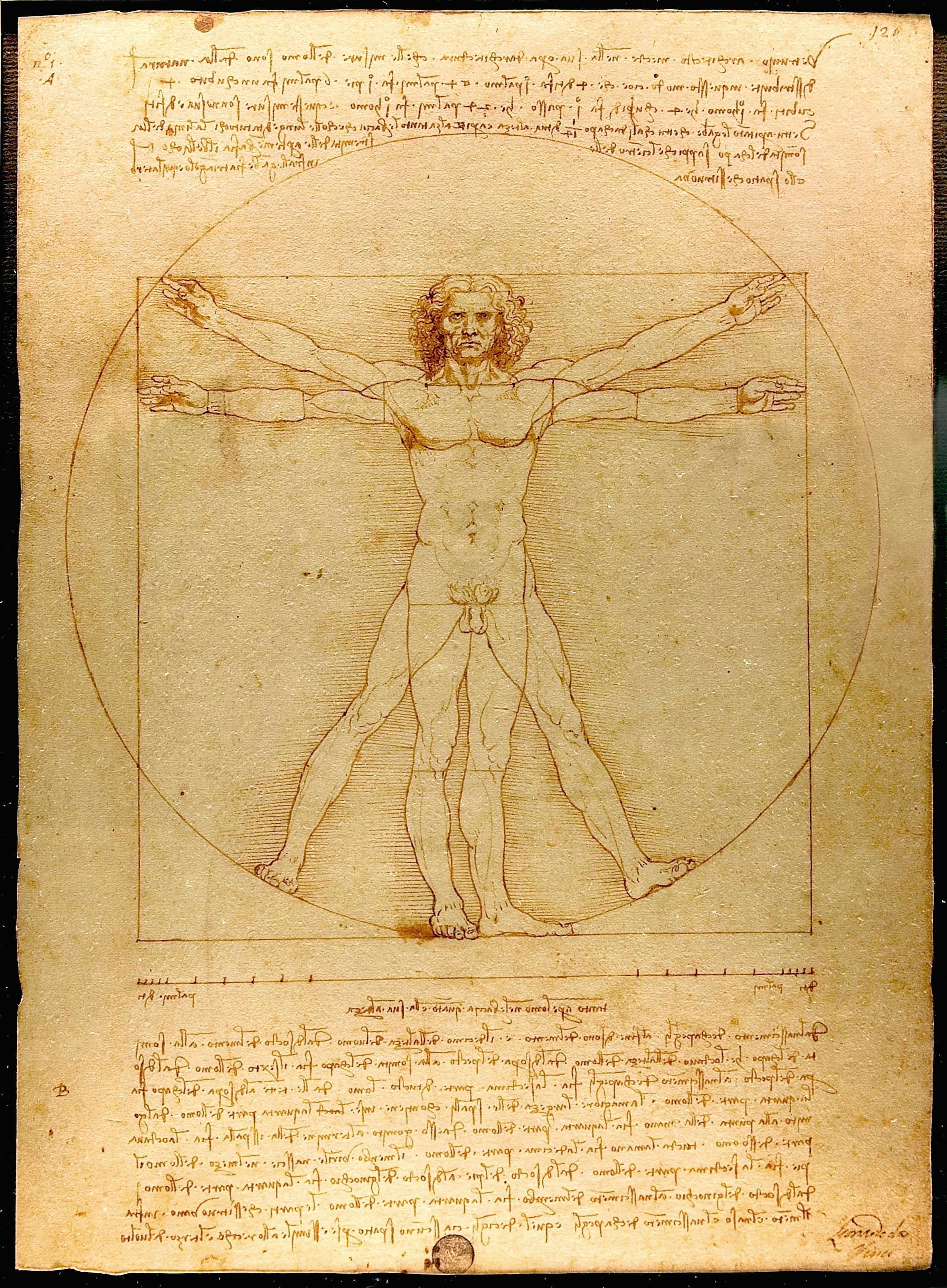
The Vitruvian Man by Leonardo da Vinci